


The last time global real estate investment trusts (GREITs) lagged global equities by as much as they do now, Australia was over-excited about One.Tel and living rooms crackled to the sound of dial-up internet.
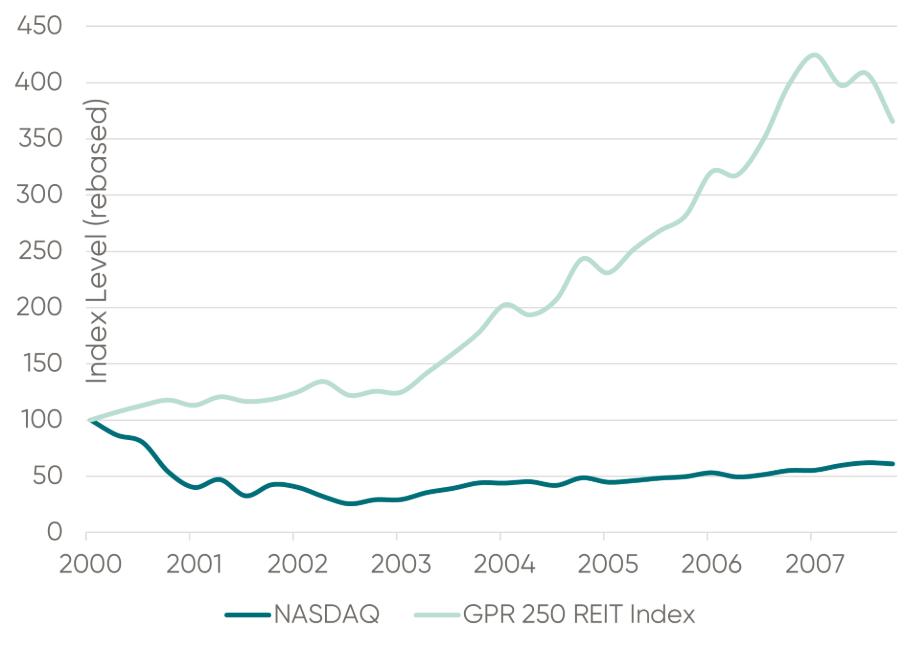
The dotcom bubble had left REITs for dead. Then the bubble burst and REITs did what neglected asset classes tend to do when normality returns; they bounced back.
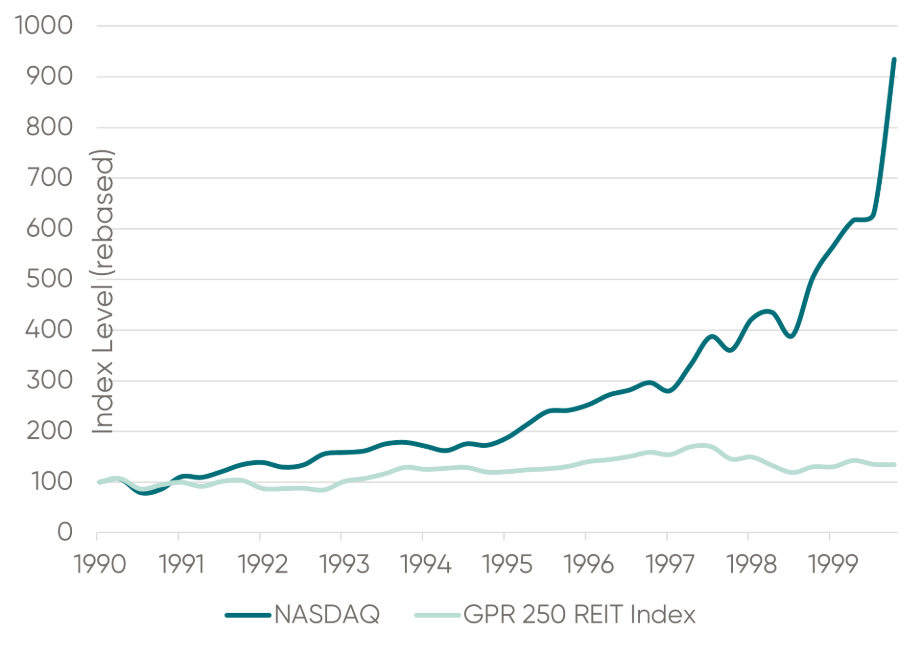
The chart below (left) shows the US NASDAQ index between 1990 and 1999 outperforming global REITs, while the chart to the right shows their resurrection.
NASDDAQ vs. Global REITs leading into the Dot-com Bubble
NASDDAQ vs. Global REITs after the Dot-com Bubble
Source: JP Morgan Research, DXAM. Past performance is not a reliable indicator of future performance
Today’s circumstances aren’t identical but the echoes are audible. Global REITs have now underperformed global equities for four consecutive years, the longest period in over two decades.
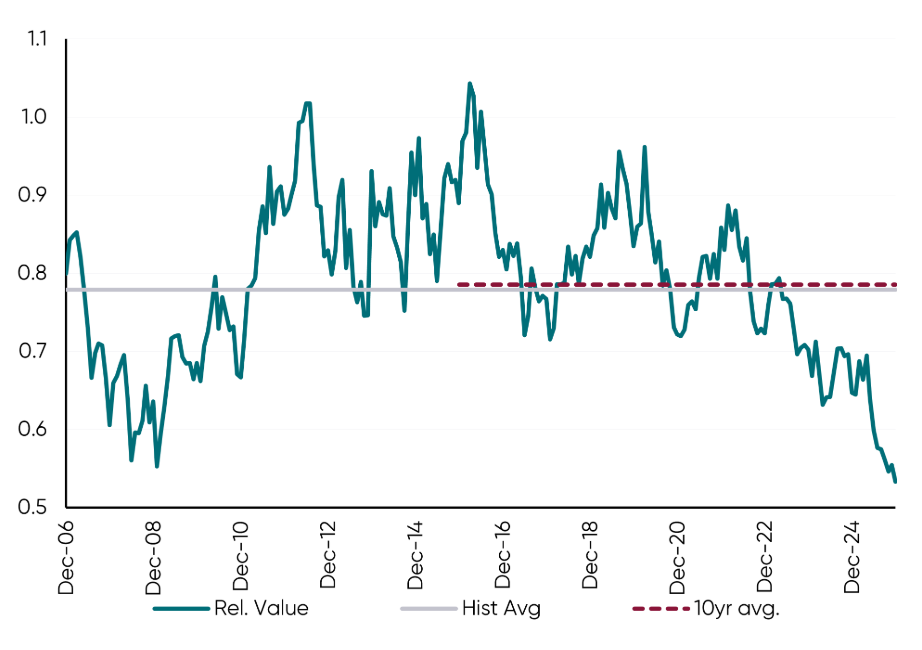
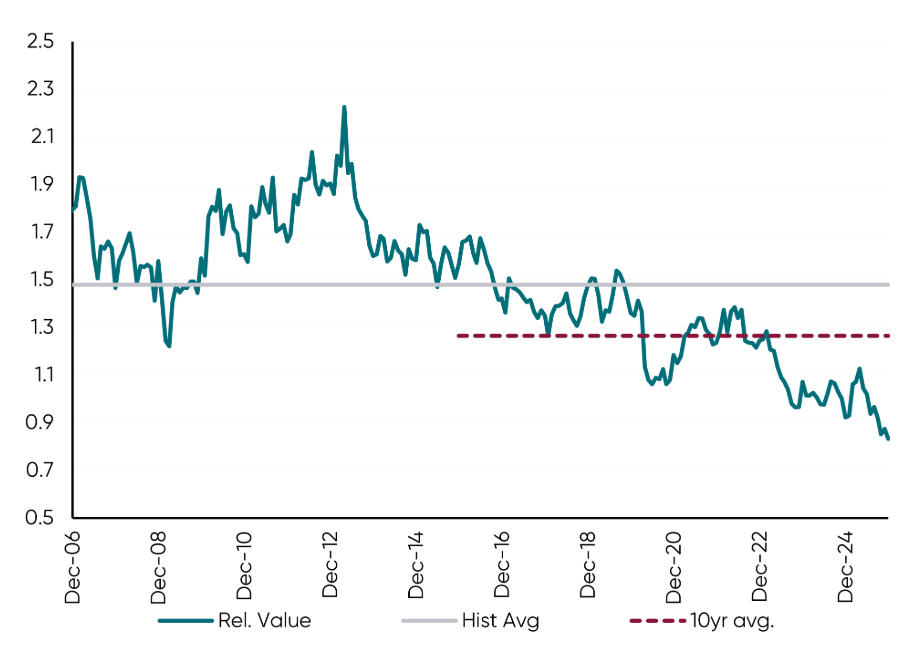
Unlike in the Dotcom era and the pandemic, recent pessimism has accumulated slowly. The effect, however, has been the same. Relative to equities, on key valuation measures GREITs are trading significantly below historical averages.
The purported impacts of artificial intelligence (AI) at one end of global markets has created some speculative excess. At the other, in commercial property, there are ongoing macroeconomic concerns, compounded by the shift to work-from-home, white collar employment and cost of living pressures.
The result is that GREITs have been all but forgotten. Relative valuations have plumbed levels not reached in decades.
Price / Book value
Global Listed Real Estate vs Equities
Price / Cash Flow
Global Listed Real Estate vs Equities
Source: DXAM, UBS. Past performance is not a reliable indicator of future performance.
For an active investment strategy like the Dexus Global REIT Fund, where investment decisions are based on data more so than narrative, this is a time of opportunity.
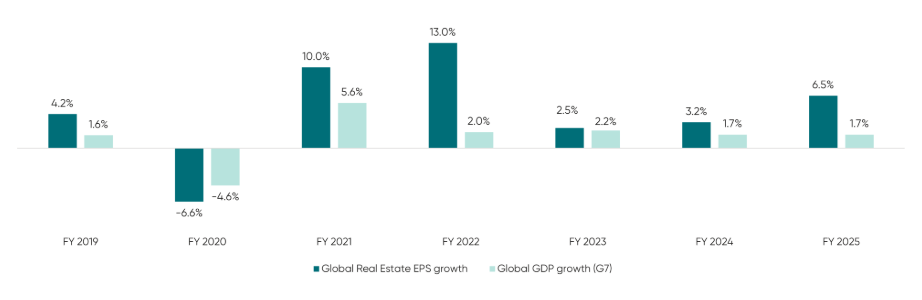
The evidence is compelling. GREIT earnings rebounded strongly after the pandemic and have actually exceeded economic growth after conditions normalised. While the returns in the chart below suggest some volatility, they do not substantiate the discounts implied by public market pricing. Indeed, earnings growth shows increasing momentum, in our view.
Historical global real estate sector earnings growth vs. GDP growth*
Source: IBES, Datastream, UBS, DXAM
*This graph has not been prepared by DXAM and the information in it is predictive in nature. Global EPS & GDP growth (YoY) is average of US, UK, EU, AU, JP, HK, and Singapore. Any forward looking statements are based on estimates and assumptions related to future business, economic, market, political, social and other conditions that are inherently subject to significant uncertainties, risks and contingencies, and the assumptions may change at any time without notice. The statements may therefore be affected by inaccurate assumptions or by known or unknown risks and uncertainties. Actual results ultimately achieved may differ materially from those predicted or implied by any forward looking statements and are not guaranteed to occur. The forward looking statements only speak as at the date of this material, and except as required by law, DXAM disclaims any duty to update them to reflect new developments. Past performance is not a reliable indicator of future performance.
There are other reasons for investors to be enthusiastic.
First, commercial property is primarily an investment in an income stream. Leases are contractual and long-term, rents typically rise with or ahead of inflation and revenue is reliable. GREITs are classically defensive assets, with growth potential.
Due to booming equity markets, many investors are now underweight real estate. This is an opportune time for investors to rebalance their portfolios, lock in some gains and increase their exposure to GREITs, in our view.
Second, these defensive characteristics are available at compelling prices. We believe GREITs might be well positioned to outperform equities, offering dividend yield, earnings growth and valuation upside.
On a risk‑adjusted basis, low‑teens returns may be a realistic expectation, although as we’ll explain in part two, not all GREITs are created equal.
Third, the strength of the investment case is unlikely to be undone but expanding supply. Construction and financing costs are now higher and projects have been delayed or shelved. Implications of this dynamic is likely to be ongoing market rental tension, benefiting incumbent REIT landlords.
According to JLL forecasts, across office, industrial, retail and other sectors, completions in 2026 will be lower than in the 2021–25 peak. Supply is tightening, not expanding. That’s good for GREIT earnings growth.
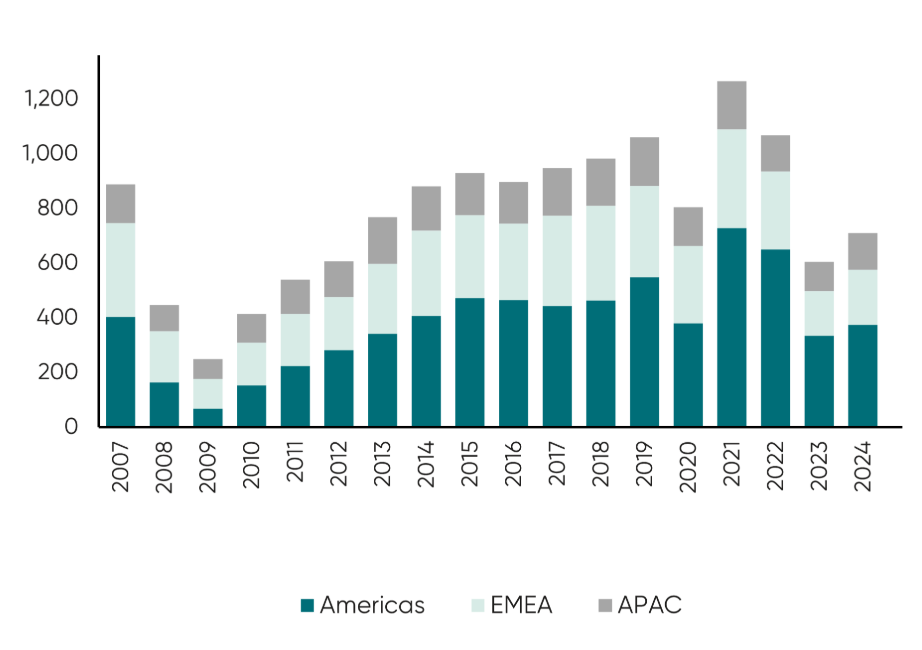
Fourth, private market transactions support valuations and prospective earnings growth. Private buyers, deploying real capital, tend to be more pragmatic than investors in listed markets. The recent increase in mergers and acquisition activity bolsters the investment case.
There are other reasons for investors to be enthusiastic.
Direct commercial real estate transaction volumes ($bn)
Source: UBS/JLL
Fifth, inflation and interest rates are moving into more favourable territory. Historically, GREIT returns have been strongest when inflation is in a 2–3 per cent band.
Current running yields for global REIT portfolios are in the mid-single digits. The Dexus Global REIT Fund, for example, offers a current running yield of 3.72%.
Let’s say that dividend yields contribute 3–5 per cent and earnings grow at mid-single digits, too. Even if GREIT share prices stay exactly where they are, this would imply returns in the high single digits.
However, it’s quite possible the valuation discount closes over the next few years – we can’t say when exactly, but that’s usually what happens. Add these factors together and low-teens total returns are plausible, especially on a risk-adjusted basis.
For investors seeking a more defensive posture without sacrificing the potential for total returns, this is an ideal time. That’s why we believe global listed property looks less like a relic and more like a mispriced opportunity hiding in plain sight. In part two, we’ll explain exactly where to look.
Invest in GREIT
The Dexus Global REIT Fund (DXGRF) is an investment strategy for global listed property developed to target higher income with low relative risk while maintaining the real value of capital over the investment time horizon. The fund invests in the developed markets of North America, Europe and Asia.

More insights

Data centres: Existing beats imaginary
The AI boom is accelerating demand for computing capacity, but constrained power and infrastructure mean existing data centres may offer the most compelling investment opportunity.
08 Sep 2026

David Kruth appears on Investment Matters
David Kruth and Darren Connolly explore the evolution of global REIT markets, examining the shift toward modern, growth‑oriented property sectors and the implications for today’s investors.
15 Apr 2026

Webinar: Global REITs – Mispriced in Plain Site
John Taylor and David Kruth sit down to discuss the current mispricing across global listed real estate, highlighting compelling opportunities in Real Estate Investment Trusts (REITs) created by discounts to private market valuations.
11 Mar 2026

Mispriced in Plain Site: The case for Global REITs - Part 3
Part 3 of “Mispriced in Plain Site" shows how the Dexus GREIT Fund turns mispricing into opportunity, backing sectors with structural tailwinds and using active conviction to capture value the index never sees.
03 Mar 2026

Mispriced in Plain Site: The case for Global REITs - Part 2
With valuations improving and dispersion creating clear winners and losers, this is not a time to own the average. The Dexus Global REIT Fund targets the most compelling opportunities globally, backed by active stock selection and a focus on capital preservation.
26 Feb 2026

8 Lessons from London: What Investors Are Missing in Global REITs
At the recent UBS Global Real Estate Conference in London, a key investing lesson was subtly but forcefully reiterated: stocks can stay mispriced for longer than you might expect.
12 Jan 2026

Global REITs: A mispricing opportunity investors can’t ignore
Global Real Estate Investment Trusts (REITs) are almost always sold on the same two hooks. The first is international diversification—the very sensible idea that you shouldn't have all your eggs in an Australian basket.
02 Dec 2025

DXGRF Q3 2025 Quarterly Snapshot
The Dexus Global REIT Fund achieved a 4.40% return, outperforming its benchmark by 59 basis points. Mark Mazzarella discusses strong stock selection and the Fund's focus on resilient income streams and long-term opportunities, even amid market uncertainty.
14 Nov 2025
Important
This (“Material”) has been prepared by Dexus Asset Management Limited (ACN 080 674 479, AFSL No. 237500) (“DXAM”), the responsible entity and issuer of the financial products of Dexus Global REIT mentioned in this Material. DXAM is a wholly owned subsidiary of Dexus (ASX: DXS).
Information in this Material is current as at February 2026 (unless otherwise indicated), is for general information purposes only, does not constitute financial product advice and does not purport to contain all information necessary for making an investment decision. It is provided on the basis that the recipient will be responsible for assessing their own financial situation, investment objectives and particular needs. Before you receive any financial service from us (including deciding to acquire or to continue to hold a product in any fund mentioned in this Material), investors should read the relevant product disclosure statement (“PDS”), financial services guide (“FSG”) and target market determination (“TMD”) in full, and seek independent legal, tax and financial advice. The PDS, FSG and TMD (hard copy or electronic copy) are available from DXAM by visiting https://www.dexus.com/investor-centre, by emailing investorservices@dexus.com or by phoning 1800 996 456. The PDS contains important information about risks, costs and fees (including fees payable to DXAM for managing the fund). Any investment is subject to investment risk, including possible delays in repayment and loss of income and principal invested, and there is no guarantee on the performance of the fund or the return of any capital. This Material does not constitute an offer, invitation, solicitation or recommendation to subscribe for, purchase or sell any financial product, and does not form the basis of any contract or commitment. This Material must not be reproduced or used by any person without DXAM’s prior written consent. This Material is not intended for distribution or use in any jurisdiction where it would be contrary to applicable laws, regulations or directives.
Any forward-looking statements, opinions and estimates (including statements of intent) in this Material are based on estimates and assumptions related to future business, economic, market, political, social and other conditions that are inherently subject to significant uncertainties, risks and contingencies, and the assumptions may change at any time without notice. Actual results may differ materially from those predicted or implied by any forward-looking statements for a range of reasons. Past performance is not an indication of future performance. The forward-looking statements only speak as at the date of this Material, and except as required by law, DXAM disclaims any duty to update them to reflect new developments.
Except as required by law, no representation, assurance, guarantee or warranty, express or implied, is made as to the fairness, authenticity, validity, suitability, reliability, accuracy, completeness or correctness of any information, statement, estimate or opinion, or as to the reasonableness of any assumption, in this Material. By reading or viewing this Material and to the fullest extent permitted by law, the recipient releases Dexus, DXAM, their affiliates, and all of their directors, officers, employees, representatives and advisers from any and all direct, indirect and consequential losses, damages, costs, expenses and liabilities of any kind (“Losses”) arising in connection with any recipient or person acting on or relying on anything contained in or omitted from this Material or any other written or oral information, statement, estimate or opinion, whether or not the Losses arise in connection with any negligence or default of Dexus, DXAM or their affiliates, or otherwise.
Dexus, DXAM and/or their affiliates may have an interest in the financial products, and may earn fees as a result of transactions, mentioned in this Material.
How can we help?
Connect with us to explore investment opportunities, find the right space for your best work or learn more about what we do. Together, let’s create tomorrow.