


Across the globe, demand for computing capacity is accelerating. Global power demand from data centres is forecast to increase 165% by 20301.
Unfortunately, the infrastructure needed to satisfy it, electricity, transmission, substations, cooling and planning approvals remains stubbornly, awkwardly physical.
This inconvenient fact is reshaping the data-centre market worldwide and presenting opportunities for investors prepared to look a little deeper into the sector.
The paradox of rapidly increasing digital demand and obdurate physical supply is an opportunity. At the recent Rhombus Advisory conference in Ho Chi Minh City, Vietnam, analyst estimates suggested hyperscaler capital expenditure will rise from about US$388billion in 2025 to US$630 billion in 2026.
Chart 1: Hyperscaler capex and AI pilot goal
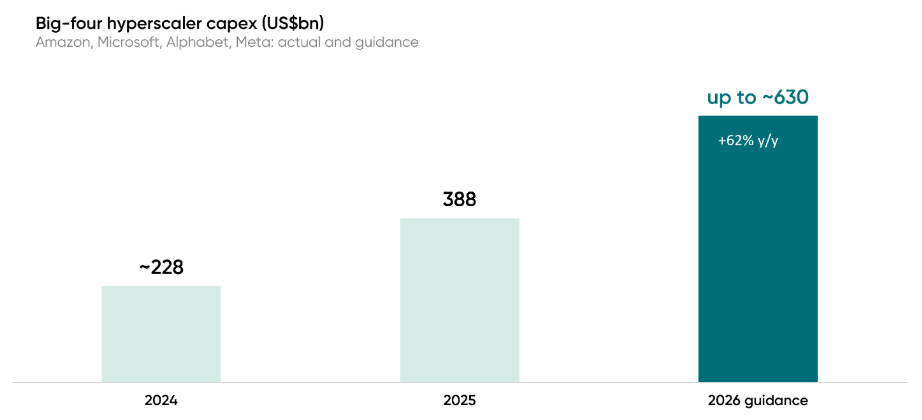
Source: Amazon, Microsoft, Alphabet, Meta. Synergy Research Group. JLL., DXAM
This breathtaking sum is having a huge impact. The Economist wrote in August last year that, “Something like a sixth of the 2% rise in American GDP over the past year has come from investments in computer and communications equipment, including chips, and data centres.”
Given the money flooding into the sector, the reliance on AI infrastructure is likely to have only accelerated since.
And yet this isn’t a new phenomenon. Long before ChatGPT, cloud computing, storage and streaming were contributing to the huge growth in global digital data. AI has poured petrol on a roaring fire. With corporate adoption barely underway (see chart above, right), today’s computing requirements could look modest compared to what’s ahead.
Data centre growth is one of the major themes I addressed in an insights article I wrote in June last year (see Demographics and Technology: Themes driving Global REIT opportunity). Since then, the opportunity has only deepened.
The reason for that is straightforward: while the demand side of the equation is clear, the supply response is constrained and complex.
The general public tends to see data centres as large sheds filled with expensive computers. Yet every facility requires grid connections, transformers, land, regulatory approval and lots of reliable electricity.
Power transformers face delivery times of two to three years and grid bottlenecks can add two years or more to construction schedules. Last December, the Financial Times reported that “data centres face wait times of up to seven years to connect to the grid” while some are purchasing jet engines to shorten delays.
Then there are the growing financing and building costs, scarce serviced land and planning delays, exacerbated by growing public distrust in the sector.
The contrast with industrial development is useful. Logistics projects benefit from relatively simple buildings and short delivery periods, lowering the chance of demand or capital markets changing before completion. Data centres, on the other hand, are technically complicated, power-hungry and hostage to someone else’s infrastructure.
For investors, the temptation is to pursue the biggest development pipeline and think of it as growth. Unfortunately, these investors may be swapping the prospect of future operating income for construction, financing and pre-leasing risk, plus a potentially troubled relationship with the electricity grid. There is a huge difference between a development pipeline and an income stream.
We’d suggest another approach. Existing data centres have already cleared the hurdles confronting new builds developments. They possess something increasingly difficult to reproduce: live, reliable capacity.
Established operators are already collecting rent and colocation income. Customers are reluctant to move critical systems, while interconnection - the web of networks, cloud platforms and customers inside a facility makes successful centres more useful as they grow.
This is a crucial point. The moat of a data centre is not the building but the power, connections, tenants and ecosystem inside it. Existing operators can also benefit from lease resets, expansion within established locations and development on sites where power and approvals have already been secured.
This should place global REITs such as Equinix a conviction holding in the Dexus Global REIT Fund at the forefront of investors’ minds.
Not every proposed data centre project will secure power, arrive on time or earn an acceptable return. Those that already exist are far better placed to do so, in our view.
With robust development economics and reduced risk where preleasing is possible, this is a sector offering the prospect of higher growth, something that the Dexus Global REIT Fund is already taking advantage of.
The Fund invests in a portfolio of Real Estate Investment Trusts (REITs) listed in North America, Europe and Asia Pacific. We focus on regions and property types where developing structural trends like data centres and local fundamentals are driving sustained rental growth and total investment returns.
We’ll admit this isn’t the heroic version of the AI trade. It requires no robots or moon bases just scarce, connected assets collecting rent while the digital economy competes for capacity. For us at least, rarely has dull infrastructure looked so interesting.
1 AI and data center power demand, Goldman Sachs 2025
Invest in GREIT
The Dexus Global REIT Fund (DXGRF) is an investment strategy for global listed property developed to target higher income with low relative risk while maintaining the real value of capital over the investment time horizon. The fund invests in the developed markets of North America, Europe and Asia.

More insights

David Kruth appears on Investment Matters
David Kruth and Darren Connolly explore the evolution of global REIT markets, examining the shift toward modern, growth‑oriented property sectors and the implications for today’s investors.
15 Apr 2026

Webinar: Global REITs – Mispriced in Plain Site
John Taylor and David Kruth sit down to discuss the current mispricing across global listed real estate, highlighting compelling opportunities in Real Estate Investment Trusts (REITs) created by discounts to private market valuations.
11 Mar 2026

Mispriced in Plain Site: The case for Global REITs - Part 3
Part 3 of “Mispriced in Plain Site" shows how the Dexus GREIT Fund turns mispricing into opportunity, backing sectors with structural tailwinds and using active conviction to capture value the index never sees.
03 Mar 2026

Mispriced in Plain Site: The case for Global REITs - Part 2
With valuations improving and dispersion creating clear winners and losers, this is not a time to own the average. The Dexus Global REIT Fund targets the most compelling opportunities globally, backed by active stock selection and a focus on capital preservation.
26 Feb 2026

Mispriced in Plain Site: The case for Global REITs - Part 1
Global REITs are shaping up as one of the most overlooked opportunities in global markets today. After years of being priced for caution, fundamentals are now strengthening while valuations remain at levels not seen in decades.
25 Feb 2026

8 Lessons from London: What Investors Are Missing in Global REITs
At the recent UBS Global Real Estate Conference in London, a key investing lesson was subtly but forcefully reiterated: stocks can stay mispriced for longer than you might expect.
12 Jan 2026

Global REITs: A mispricing opportunity investors can’t ignore
Global Real Estate Investment Trusts (REITs) are almost always sold on the same two hooks. The first is international diversification—the very sensible idea that you shouldn't have all your eggs in an Australian basket.
02 Dec 2025

DXGRF Q3 2025 Quarterly Snapshot
The Dexus Global REIT Fund achieved a 4.40% return, outperforming its benchmark by 59 basis points. Mark Mazzarella discusses strong stock selection and the Fund's focus on resilient income streams and long-term opportunities, even amid market uncertainty.
14 Nov 2025
Disclaimer and important notes
Dexus Asset Management Limited (ACN 080 674 479, AFSL 237500) ("Responsible Entity") is the responsible entity of the Dexus Global REIT Fund (ARSN 642 411 292) (“DXGRF” or “Fund”) and issuer of units in the Fund. The Responsible Entity is a wholly owned subsidiary of Dexus (ASX: DXS).
This document has been prepared for informational purposes only and is not an offer, solicitation, or invitation to invest in the Fund.
The information in this document, including, without limitation, any forward-looking statements, or opinions (“Information”), may be subject to change without notice. Any forward-looking statements or opinions are based on estimates and assumptions related to conditions such as future business, economic, market, political, social or other conditions, that are inherently subject to significant uncertainties and risks. Actual results may differ materially from those predicted or implied by any forward-looking statements or opinions for a range of reasons.
While care has been taken in the preparation of this document, the Responsible Entity, Dexus, their related bodies corporate and their officers, employees and advisers make no representation or warranty, express or implied, as to the currency, accuracy, reliability or completeness of the Information. The Information should not be considered to be comprehensive or to comprise all the information which an investor or potential investor may require in order to determine whether to invest or deal in the Fund. Accordingly, to acquire or to continue to hold units in the Fund, investors will need to consider the product disclosure statement (“PDS”), target market determination (“TMD”) and all other relevant continuous disclosure materials for the Fund (“Disclosure Materials”). The PDS, TMD and Disclosure Materials contain important information about investing in the Fund and it is important that investors read them before making an investment decision about the Fund. The PDS, TMD and Disclosure Materials are available at www.dexus.com/dxgrf or by contacting us.
This document has been prepared for the purpose of providing general information, without taking account of any particular investor’s objectives, financial situation or needs. Investors should, before making any investment decisions, consider the appropriateness of the information in this document, and seek professional advice, having regard to their objectives, financial situation and needs.
The repayment and performance of an investment in the Fund (including any particular rate of return referred to in this document) is not guaranteed by the Responsible Entity, Dexus, any of their related bodies corporate or any of their officers, employees and advisers. This investment is subject to investment risk, including possible delays in repayment and loss of income and principal invested.
Past performance is not a reliable indicator of future performance.
All currency figures are expressed in Australian dollars (AUD) unless otherwise specified. This document may not be distributed to any person in any jurisdiction outside Australia where it would be contrary to applicable laws, regulations or directives.
Due to rounding, any numbers presented throughout this presentation may not add up precisely to the totals provided and percentages may not precisely reflect the absolute figures.