


For income investors, there was a time when Australian real estate investment trusts (AREITs) were a ‘must have’.
However, in the current climate, driven by artificial intelligence fever and a flight to purported safety in well known, large capitalisation stocks, share markets around the world are at or near record highs. Dependable AREITs have been forgotten in the rush.
For active managers like Dexus, the extent of the disinterest is a measure of the opportunity. When a sector becomes unloved, prices often detach from reality.
As Dexus Global REIT Fund Portfolio Manager David Kruth put it in Mispriced in plain site: The case for global REITs, “The last time GREITs lagged global equities by as much as they do now, Australia was over excited about One.Tel and living rooms crackled to the sound of dial up internet.”
In this article, we’ll address one of the issues we think might be holding investors back from availing themselves of this opportunity. First, though, let’s examine the current predicament.
The Reserve Bank of Australia has raised interest rates three times since the beginning of the year. With core inflation rising, markets are forecasting a fourth. This is negative for rate sensitive sectors like real estate because higher rates increase funding costs, place downward pressure on valuations and raise concerns around debt serviceability and growth.
These concerns are evident in the numbers. As Australia’s 10-year bond yield hit cyclical highs above 5% in March, the AREIT 300 Index fell to a 52 week low, down 16% over the month. This narrative may have taken root in AREIT pricing, but it ignores a more fundamental perspective; debt simply isn’t the issue investors believe it is.
The AREIT sector experienced a period of increased leverage before the Global Financial Crisis (GFC), with gearing reaching 44% in 20071. It destroyed some of the most storied companies in the sector.
Since then, it has returned to its knitting. Before the Covid-19 pandemic, average sector gearing had fallen to 29%. By June 2025, it had fallen to 26%, surviving the trickiest environment since the financial crisis. Currently, average gearing across the sector remains at about 27%—well below historical averages.
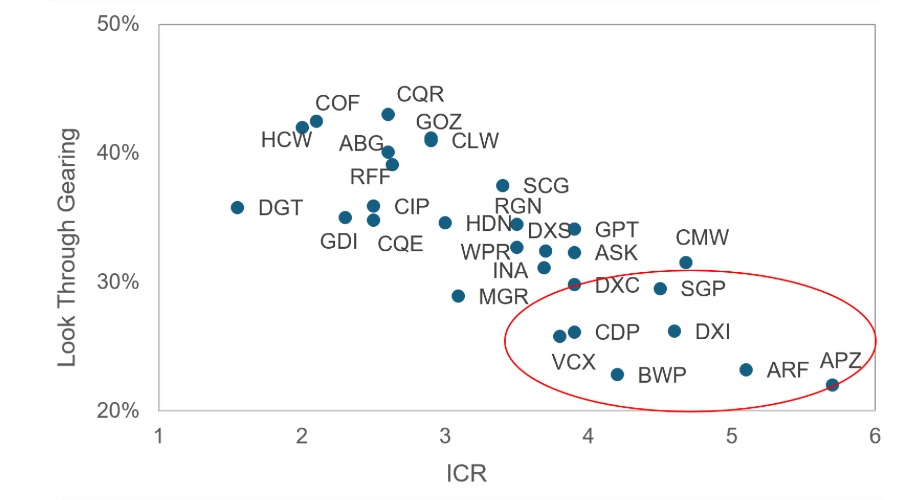
Another measure of financial wellbeing, the interest cover ratio (ICR), which measures an AREIT’s ability to pay interest on its outstanding debt is also in rude health. This is important because, as the GFC proved, it's an indicator of solvency and dividend reliability.
Chart 1: Interest cover ratios and gearing by AREIT
Source: Individual company disclosure as Dec 25
Whilst the Dexus AREIT Fund is focused on stocks with low gearing and high interest cover in the lower right quadrant, more than half of all AREITs report an ICR greater than three times, comfortably above the standard covenant threshold of two times.
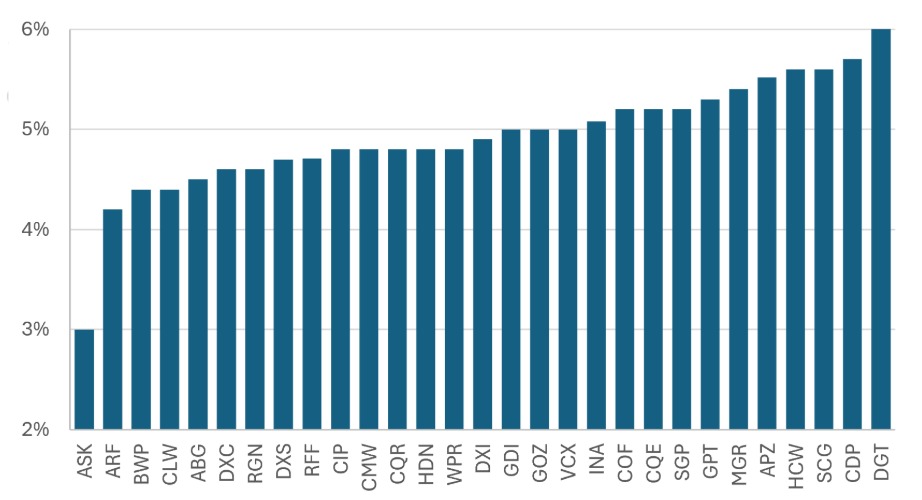
The sector has also done a good job of lowering not just the amount of debt it carries but also managing the per dollar costs of servicing it.
Rising rates remain a concern, but much of the impact has already been incorporated. With the average cost of debt at about 5.5%, the sector has already repriced a significant portion of its debt base. The market is overestimating the immediate impact of rising rates.
Chart 2: First half FY2026 debt costs by AREIT
Source: Individual company’s disclosure as Dec 25
Credit margin compression is another benevolent factor. As lenders chase higher quality borrowers like AREITs, they’ve been able to refinance at relatively lower margin. These margin savings have partially offset the impact of recent rate rises.
The impact of higher rates cannot be eliminated, but the incremental impact on earnings and serviceability is less severe than headline rates imply.
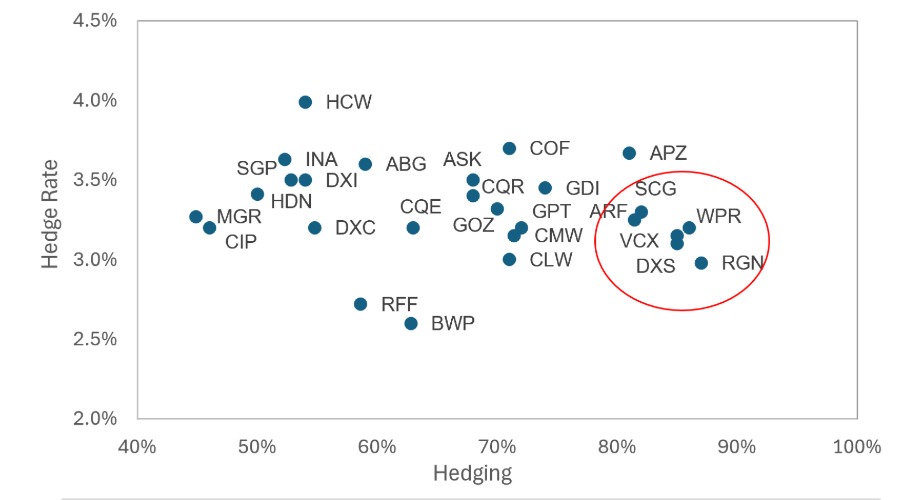
The sector’s conservative hedging strategy is another critical differentiator. Many AREITs have over 75% of their debt hedged into FY27, with the full impact of higher rates deferred, at the earliest, to FY28. In other words, the rate cycle impact is not immediate; it is lagged and manageable.
Chart 3 – FY27 hedging and hedge rate by AREIT
Source: Individual company’s disclosure as Dec 25
In the past, real estate valuation was driven by capitalisation rate compression; as interest rates fell, assets became more valuable. That remains true to an extent. Indeed, it goes a long way to explaining why the sector is currently trading at a ~8% discount to net tangible assets (NTA) (excluding the fund managers), broadly in line with the valuation levels seen during the 2022 tightening cycle.
But the focus is shifting decisively toward income growth. High occupancy levels, strong leasing outcomes and CPI linked rental escalations offer a structural tailwind for income growth, which in turn strengthens debt serviceability.
Investors have been slow to recognise this reality and the opportunity. In our view, the disconnect is unjustified. The AREIT sector is fundamentally sound, conservatively geared and boasts resilient income streams.
For income investors willing to look past the empty breakfast rooms and the "unloved" label, the current mispricing is creating selective, high value opportunities.
AREITs with lower balance sheet risk, strong hedging profiles and CPI linked rental incomes like Vicinity Centres (retail exposure with resilient income dynamics) and Arena REIT (alternative REIT with defensive earnings profile) are examples of our approach.
In a higher-for-longer rate environment, the focus must remain on disciplined balance sheets and assets with pricing power. That is where the real opportunity lies.
That’s why we think AREITs are past the worst of it; this remains a time of opportunity for those with the patience to look and the need for stability in a time of discord.
1 See A multi factor analysis of AREIT returns, a 2009 paper from Jaime L.P. Yong of Edith Cowan
Invest in AREITs
The Dexus AREIT Fund (DXAF) is an income-focused property securities fund that invests in a portfolio of listed Australian Real Estate Investment Trusts (AREITs).

More insights

AREIT reporting season: 8 key takeaways
Many AREIT investors fear the impact of higher interest rates. Results from the latest reporting season should allay those fears. AREIT pricing already accounts for that prospect, although in many cases private asset values do not.
21 Sep 2026

Why the new tax regime could spark a revival in AREITs
In the last seven months, Dexus has made the case that many Australian Real Estate Investment Trusts (AREITs) are trading at discounted valuations (see AREITs: The case for stability and growth and Through war and economic adjustments). Many AREITs remain undervalued.
26 May 2026

AREITs: Through War and Economic Adjustments - Part 2
A sector-driven lens reveals where resilience lies in today’s AREIT landscape. Highlighting retail strength, selective sector opportunities, and how inflation-linked income and disciplined capital management can underpin durable returns.
18 May 2026

AREITs: Through War and Economic Adjustments - Part 1
A changing macro environment is redefining opportunities in AREITs, highlighting how inflation-linked income, strong balance sheets and constrained supply may support resilient returns despite higher rates.
15 May 2026

AREIT reporting season wrap: 10 key takeaways
The recent reporting season shows the AREIT sector is enjoying improving fundamentals and strengthening capital markets creating compelling opportunities for investors.
30 Mar 2026

DXAF Q3 2025 Quarterly Snapshot
The Fund returned 7.62% in September, outperforming its benchmark by 285 bps. Supported by solid income growth, attractive valuations, and falling interest costs, AREITs remain well positioned for long-term growth without relying on further rate cuts.
13 Nov 2025

AREITs: The case for stability and growth
There is something unusual going on in markets right now. Traditionally, share markets and the gold price have operated inversely. When stocks are highly priced, gold tends to be unpopular and vice versa. One is risk-on, the other risk-off.
09 Nov 2025

AREIT capital structures in great shape, here are two set to benefit
When a business fails, it is usually due to excessive debt. In the 2008 financial crisis, this was a lesson the AREIT sector learned the hard way. At the time, average AREIT gearing was above 40%. For a supposedly conservatively managed investment designed to deliver stable regular dividends, the figure was too high.
01 Oct 2025
Disclaimer and important notes
Dexus Asset Management Limited (ACN 080 674 479, AFSL 237500) ("Responsible Entity") is the responsible entity of the Dexus AREIT Fund (ARSN 134 361 229) (“DXAF” or “Fund”) and issuer of units in the Fund. The Responsible Entity is a wholly owned subsidiary of Dexus (ASX: DXS).
This document has been prepared for informational purposes only and is not an offer, solicitation, or invitation to invest in the Fund.
The information in this document, including, without limitation, any forward looking statements, or opinions (“Information”), may be subject to change without notice. Any forward looking statements or opinions are based on estimates and assumptions related to conditions such as future business, economic, market, political, social or other conditions, that are inherently subject to significant uncertainties and risks. Actual results may differ materially from those predicted or implied by any forward looking statements or opinions for a range of reasons.
While care has been taken in the preparation of this document, the Responsible Entity, Dexus, their related bodies corporate and their officers, employees and advisers make no representation or warranty, express or implied, as to the currency, accuracy, reliability or completeness of the Information. The Information should not be considered to be comprehensive or to comprise all the information which an investor or potential investor may require in order to determine whether to invest or deal in the Fund. Accordingly, to acquire or to continue to hold units in the Fund, investors will need to consider the product disclosure statement (“PDS”), target market determination (“TMD”) and all other relevant continuous disclosure materials for the Fund (“Disclosure Materials”). The PDS, TMD and Disclosure Materials contain important information about investing in the Fund and it is important that investors read them before making an investment decision about the Fund. The PDS, TMD and Disclosure Materials are available at www.dexus.com/dxaf or by contacting us.
This document has been prepared for the purpose of providing general information, without taking account of any particular investor’s objectives, financial situation or needs. Investors should, before making any investment decisions, consider the appropriateness of the information in this document, and seek professional advice, having regard to their objectives, financial situation and needs.
The repayment and performance of an investment in the Fund (including any particular rate of return referred to in this document) is not guaranteed by the Responsible Entity, Dexus, any of their related bodies corporate or any of their officers, employees and advisers. This investment is subject to investment risk, including possible delays in repayment and loss of income and principal invested.
Past performance is not a reliable indicator of future performance.
All currency figures are expressed in Australian dollars (AUD) unless otherwise specified. This document may not be distributed to any person in any jurisdiction outside Australia where it would be contrary to applicable laws, regulations or directives.
Due to rounding, any numbers presented throughout this presentation may not add up precisely to the totals provided and percentages may not precisely reflect the absolute figures.
How can we help?
Connect with us to explore investment opportunities, find the right space for your best work or learn more about what we do. Together, let’s create tomorrow.