This article is part of a two-part series, read article 2 here.
Before Israel and the USA conflict with Iran began, domestic interest rates were already rising. Inflation remained above the RBA’s target and the war has only exacerbated preexisting trends.
This is an important juncture for AREIT investors. The notion of a return to the low-rate world to which we had become accustomed—'mean reversion’ in the language of the analyst—now looks more remote.
In the first of a two-part series, we’ll examine the ramifications of structurally higher inflation, making the case that commercial property investors should shift their focus towards AREITs offering income durability, pricing power and sound capital management. In part two, we’ll take a sector-by-sector view, explaining areas to focus on and those to avoid.
The headline is that the ramifications of the war are likely to lead to structurally higher inflation, higher government spending, higher interest rates and lower growth. Typically, this isn’t good for investors. For investors in AREITs, that’s especially the case.
These circumstances, though, are a little different. Currently, AREITs and sectors within them offer not only security of income but also the possibility of share price appreciation. Rarely do the two coincide. To explain why, we must dig a little deeper.
In a less global, more insular world, national economic resilience is being prioritised over efficiency, an effect that began during the Covid supply shock when ‘just in time’ inventory was superseded by ‘just in case’. With a more unstable geopolitical environment, this combination of factors should lead to subdued economic growth.
Policy makers, meanwhile, will likely tolerate relatively higher inflation for longer, relying on the interest rate rises and costs increases to bring this back under control. This is the backdrop against which we are analysing AREITs and the positioning of the Dexus AREIT Fund (DXAF).
Capital management
In such an era, debt becomes a more important factor. As we stated in March in AREIT reporting season wrap: 10 key takeaways, AREIT balance sheets are materially stronger and resilient now when compared to prior cycles.
They are better prepared in other ways, too. Increased hedging and intense competition amongst banks and debt markets for high-quality assets has continued to compress interest rate margins, which are at historical lows. Recent examples, even for cases after the war started, have led to margins even lower than forecast.
This is the key point: The margin compression has largely offset nearly 0.5% of the increase in the official interest rate so far this year. AREITs are now less sensitive to rate rises.
The inflation shock of higher input prices and limited availability of goods is less easily dealt with. Shipments that left the Middle East prior to the onset of war have only now arrived at their destinations. Whilst the shortage of fuel, produce and commodities has yet to fully filter through, rising prices for fuel and construction materials are already rising.
History suggests abrupt cost-of-living pressures tend to rapidly impact economic activity. The fuel hoarding, lower traffic and heightened interest and purchases of electric vehicles should be no surprise.
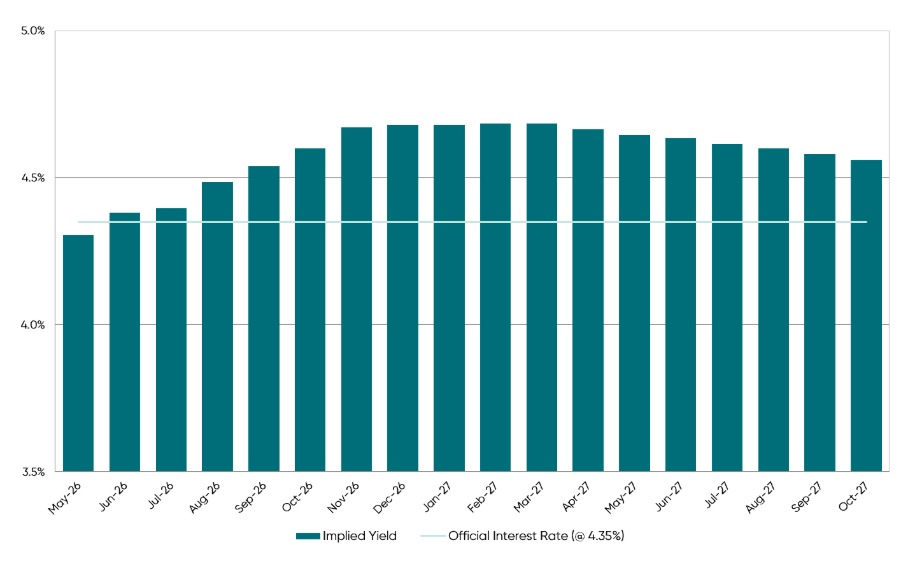
Eventually, policy makers will respond to lower growth and higher rates. As the chart below shows, the forward yield curve is already signalling reduced interest rates in 2027.
30 Day Interbank Cash Rate Future yield curve
Source: ASX
Subtle opportunity
Of course, this can change but while many investors focus on the short-term, those taking a longer view can see a subtle but valuable opportunity via three different factors.
First, due to existing hedging arrangements, many AREITs enjoy near-term protection and can re-hedge at lower rates once the cycle turns.
Second, AREIT balance sheets are generally in better condition than market sentiment implies. Whilst the global financial crisis taught investors the dangers of injudicious capital allocation and leverage, this era is not like that.
Access to debt markets has improved, loan margins have fallen, covenants have eased or been removed at no additional cost, and debt tenors have been extended. AREITs are prepared for a more challenging environment.
Third, the supply/demand balance is shifting in favour of AREITs with well-maintained assets. Last year, as interest rates fell, the sector began a long-awaited recovery. This year will be different. Any recovery is likely to be driven by rising rental growth and falling tenant incentives.
Rising replacement and construction costs have further increased the economic rent required to justify new developments. In many sectors, supply is constrained and construction were low. With costs rising, development pipelines will further tighten. The balance of power is shifting in favour of landlords.
For AREIT investors, this is an area of opportunity. Where rent growth is inflation-linked and structurally supported by tenant affordability, income growth can offset and, in some cases surpass, the valuation impact of interest rate rises.
Summary
This is a complex investing environment. War in the Middle East has materially altered the global economic outlook. We should prepare for higher inflation, higher interest rates and government spending and relatively lower growth.
This demands a shift in investors’ focus. We favour exposures where CPI-linked income growth can improve earnings, offsetting the impact of higher interest rates. The reduction in maintenance capital expenditure and tenant incentives will help. Owners of existing assets should perform more strongly as replacement costs suppress the risk of new supply.
Along with capital management discipline, we expect AREITs to perform better in the cycle ahead than where current pricing might imply.
Passive investors have exited the AREIT sector, delivering an historically attractive opportunity for those prepared to look ahead rather than respond to immediate (and, in our view, overblown) threats.
In part two, we will delve into which property sectors are set to benefit from this environment and nominate which AREITs are well positioned to deliver above average total returns in the year ahead.
Click here to read part 2.


