Australia is now home to the world’s tallest hybrid timber tower, with Atlassian Central reaching its full height of more than 180 metres in Sydney.
The five structural forces shaping real estate investing
- By Mark Mazzarella
- 10 August 2026
For commercial real estate investors, the year began with optimistic caution. That, it turns out, was warranted. The recovery that began last year was abruptly disrupted by conflict in the Middle East and sticky inflation, which remains above the Reserve Bank’s target range.
As highlighted in Dexus’s research report, Capital Foresight: Era of Dispersion, “assets with poor fundamentals continued to slide and weigh on portfolio return. Investors saw it with their own eyes, in their own portfolios: the increasing dispersion of performance.”
With the gap in asset performance continuing to widen, this alone makes a powerful case for active management. This is not a time to pick a sector or an index and hope for the best. The environment demands a depth of understanding like no other.
This is especially true given the five structural forces that will impact Australian real estate over the next cycle. Together, they will reward careful asset selection over broad sector assumptions. It will pay every real estate investor to understand them.
1. Demographics: Australia’s unique and growing advantage
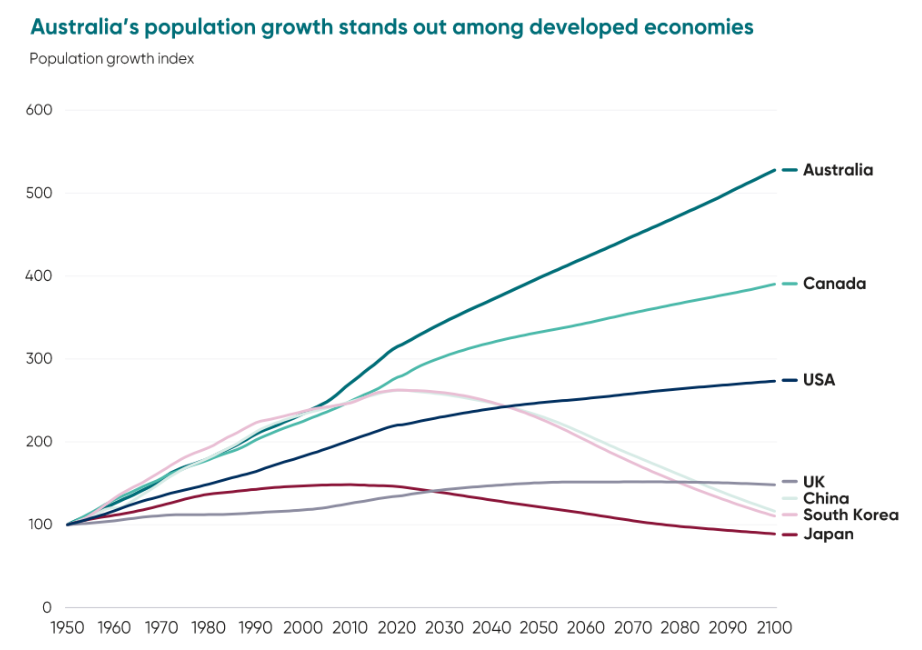
Australia’s population is forecast to increase by 1.7 million people over the next five years. As much of Europe and Asia face a flat or falling population, no developed country comes close to Australia’s rate of population growth.

Source: UN World Population Prospects 2024 medium variant, Dexus Research
This is a powerful starting point for thinking about real estate investing because each additional person needs somewhere to live, work, send their kids to school and shop, and each journey between these places requires infrastructure.
But it is not sufficient. Population composition also matters. Australians aged over 65 will be the fastest growing cohort over the next decade and those over 85 will more than triple by 2063. They will require more healthcare, retirement living and aged-care services.
Australia is also home to 800,000 international students, the second highest total in the world. This creates demand for well-located purpose-built student accommodation (PBSA). At the same time, with population growth concentrated in major cities, there is pressure to provide denser developments around transport and established services.
The investment case, therefore, is not simply about ‘more people’; it is about understanding who those people are, where they will live and what services they’ll require.
2. Cost rises, land scarcity and red tape is constraining supply
A population tailwind is not in itself an investment green flag. Strong demand only supports investment returns when supply fails to keep pace with it. In some sectors, this is already occurring.
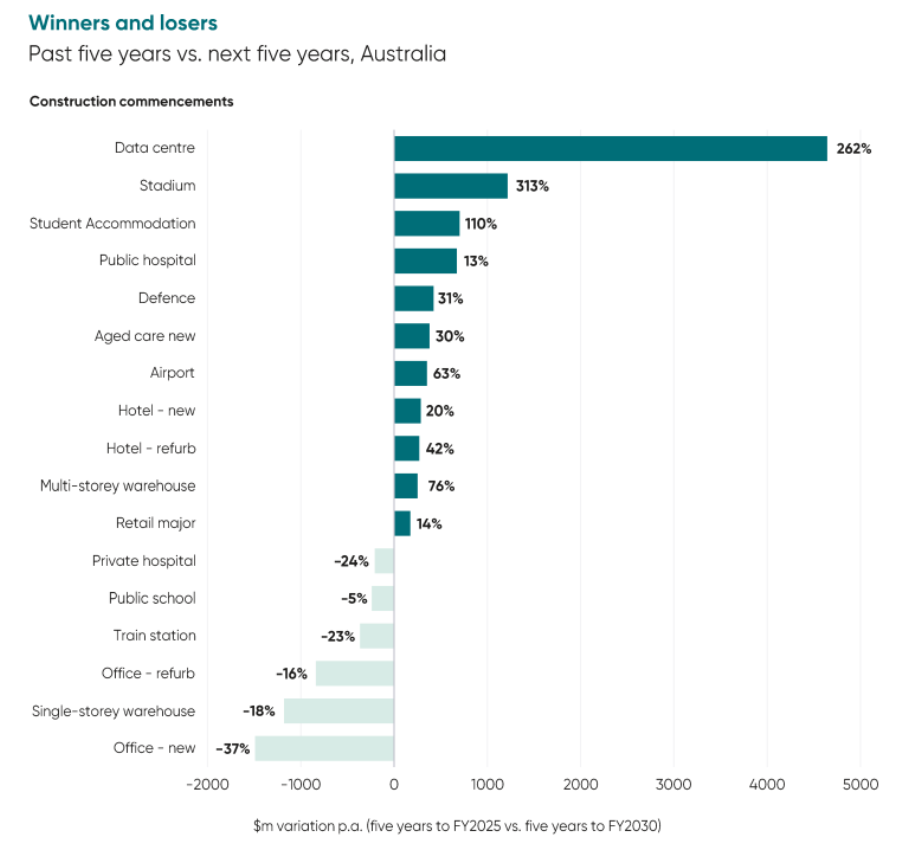
Construction and financing costs have risen, planning approvals take time and, in established locations, suitable land is scarce. At current rents, many proposed projects no longer make financial sense. They are either being delayed or cancelled altogether. Historical data points to the shortfalls.

Source: Dexus Research
Where demand is increasing and supply is constrained, rents are likely to increase. The effect is likely to be most pronounced in locations where competitors cannot easily build. For example, offices in established CBDs, dominant shopping centres and industrial properties are set to benefit.
Investors must distinguish between sectors facing a genuine supply shortage and those attracting new construction that can satisfy demand. Dexus has highlighted seniors’ living and PBSA among the assets developing pricing power due to constrained supply.
3. Technology is reallocating demand
Artificial intelligence (AI), automation and digital services do not remove the need for real assets but they are redirecting activity towards buildings and infrastructure better able to accommodate new ways of working.
In logistics, automation favours modern warehouses with power supply and layouts that deliver efficiency dividends not available in older facilities. Premium, collaborative offices will remain resilient while back-office markets are exposed to weaker demand and footprint reduction.
Because technology is reallocating demand, investors must look beyond sector labels and ask whether an individual asset enables high-value activity or gets in its way.
4. AI driven productivity gains
Productivity entails producing more from the same time, labour and capital. If AI lifts productivity, as many businesses expect it to, companies should grow faster and more profitably, wages should rise and households should spend more.
Were productivity to improve by 1.6 to 1.8 percentage points a year, it would significantly surpass the IT boom of 1995-2005, a period when the so-called Magnificent Seven hit their straps. Even sustained productivity gains of 1% a year would materially increase real wages and household spending.
For commercial real estate, a productivity-driven recovery would be different from those of the recent past. During the 2010s, property values benefited as interest rates and market yields fell.
But in an economy with growing productivity, interest rates may remain higher for longer. The implications for investors are significant; returns will need to come more from growing rents, improving occupancy and active management of buildings than lower rates.
This may mean investors should consider prioritising active over passive strategies and equity over fixed income. Real assets more exposed to higher discretionary spending are also likely to do better, as should infrastructure and experience-based retail formats.
Productivity will not benefit every property equally, but assets able to grow alongside the economy should be better placed than those offering fixed income and little room to adapt.
5. Valuation
Commercial property is largely an investment in an income stream. Leases are contractual and long-term, rents typically rise with or ahead of inflation and revenue is reliable. All of that is to say AREITs and GREITs are classically defensive assets, with growth potential.
As we explained in Mispriced in Plain Site: The case for Global REITs, booming equity markets have seen many investors underweight real estate. This applies as much to Australian investors in REITs as it does with a global orientation.
Moreover, the defensive characteristics of AREITs are currently available at compelling prices and positioned to deliver attractive risk-adjusted returns, in our view. While this is a good time for investors to rebalance their portfolios, lock in some equity gains and increase their exposure to real assets, these five structural forces mean that an active approach is necessary to maximise returns. Not all property is created equal and it could be costly to assume otherwise.
*Unless stated, all data included in this article is attributed to Capital Foresight: Era of Dispersion, Dexus, 2026.
Disclaimer and important notes
This document is issued by Dexus Funds Management Limited (ACN 060 920 783, AFSL No. 238163) (“DXFM”). DXFM is a wholly owned subsidiary of Dexus (ASX: DXS).
This document has been prepared for informational purposes only and is not an offer, solicitation, or invitation to invest in Dexus or any Dexus-managed investment vehicle.
No investment commitment or binding expression of interest can be made in connection with this document. Any investment commitment will be subject to a formal offering document prepared by the relevant Dexus-managed investment vehicle(s) in compliance with applicable laws, the constituent documents of the investment vehicle (s) and acceptance by the responsible entity, trustee and/or investment manager (as applicable) of that investment vehicle(s) of legally-binding transaction documentation executed by a prospective investor. This document may not be released or distributed in Australia except to “wholesale clients”, and only to relevant accredited investors in other jurisdictions to the extent permitted by local law. In no circumstances may this document be made available to a “retail client” within the meaning of the Corporations Act 2001 (Cth). This document is not intended for distribution or use in any jurisdiction where it would be contrary to applicable laws, regulations or directives.
This document and its contents are confidential to the person to whom it is provided and should not be copied or distributed in whole or in part or disclosed to any other person without prior written consent.
The information in this document, including, without limitation, any forward-looking statements or opinions (“Information”), may be subject to change without notice. Any forward-looking statements or opinions are based on estimates and assumptions related to conditions such as future business, economic, market, political, social or other conditions, that are inherently subject to significant uncertainties and risks. Actual results may differ materially from those predicted or implied by any forward-looking statements or opinions for a range of reasons.
While care has been taken in the preparation of this document, DXFM, Dexus, their related bodies corporate and their officers, employees and advisers make no representation or warranty, express or implied, as to the currency, accuracy, reliability or completeness of the Information. The Information should not be considered to be comprehensive or to comprise all the information which an investor or potential investor may require in order to determine whether to invest or deal in Dexus or a Dexus-managed investment vehicle.
This document has been prepared for the purpose of providing general information, without taking account of any particular investor’s objectives, financial situation or needs. Investors should, before making any investment decisions, consider the appropriateness of the information in this document, and seek professional advice, having regard to their objectives, financial situation and needs.
The repayment and performance of an investment in Dexus or a Dexus-managed investment vehicle (including any particular rate of return referred to in this document) is not guaranteed by the DXFM, Dexus, any of their related bodies corporate or any of their officers, employees and advisers. Any such investment is subject to investment risk, including possible delays in repayment and loss of income and principal invested.
Past performance is not a reliable indicator of future performance.
All currency figures are expressed in Australian dollars (AUD) unless otherwise specified.
Due to rounding, any numbers presented throughout this document may not add up precisely to the totals provided and percentages may not precisely reflect the absolute figures.
Due to rounding, any numbers presented throughout this presentation may not add up precisely to the totals provided and percentages may not precisely reflect the absolute figures.
How can we help?
Connect with us to explore investment opportunities, find the right space for your best work or learn more about what we do. Together, let’s create tomorrow.